
Understanding Passive RFID for Worksite Safety
SCAN~LINK's Core Technology
Passive RFID at a Glance
Passive RFID is a wireless identification technology that uses battery-free tags and reader antennas to detect tagged people or assets within a defined range. In worksite safety, passive RFID helps operators detect ground workers around heavy equipment, reduce blind spot risks, and prevent struck-by incidents. Because the tags need no batteries or charging, passive RFID delivers reliable, low-maintenance protection in demanding industrial environments.
- What it is: A battery-free wireless technology that identifies and detects tagged workers or assets.
- How it helps: Improves operator awareness in blind spots and supports struck-by incident prevention.
- Maintenance: Passive tags require no batteries, no charging, and virtually no upkeep.
- Common Uses: Worker detection, RFID safety apparel, and proximity warning systems around mobile equipment
What is Passive RFID?

RFID stands for Radio Frequency Identification. It is a technology that uses radio waves to identify tags attached to objects, equipment, or safety apparel.
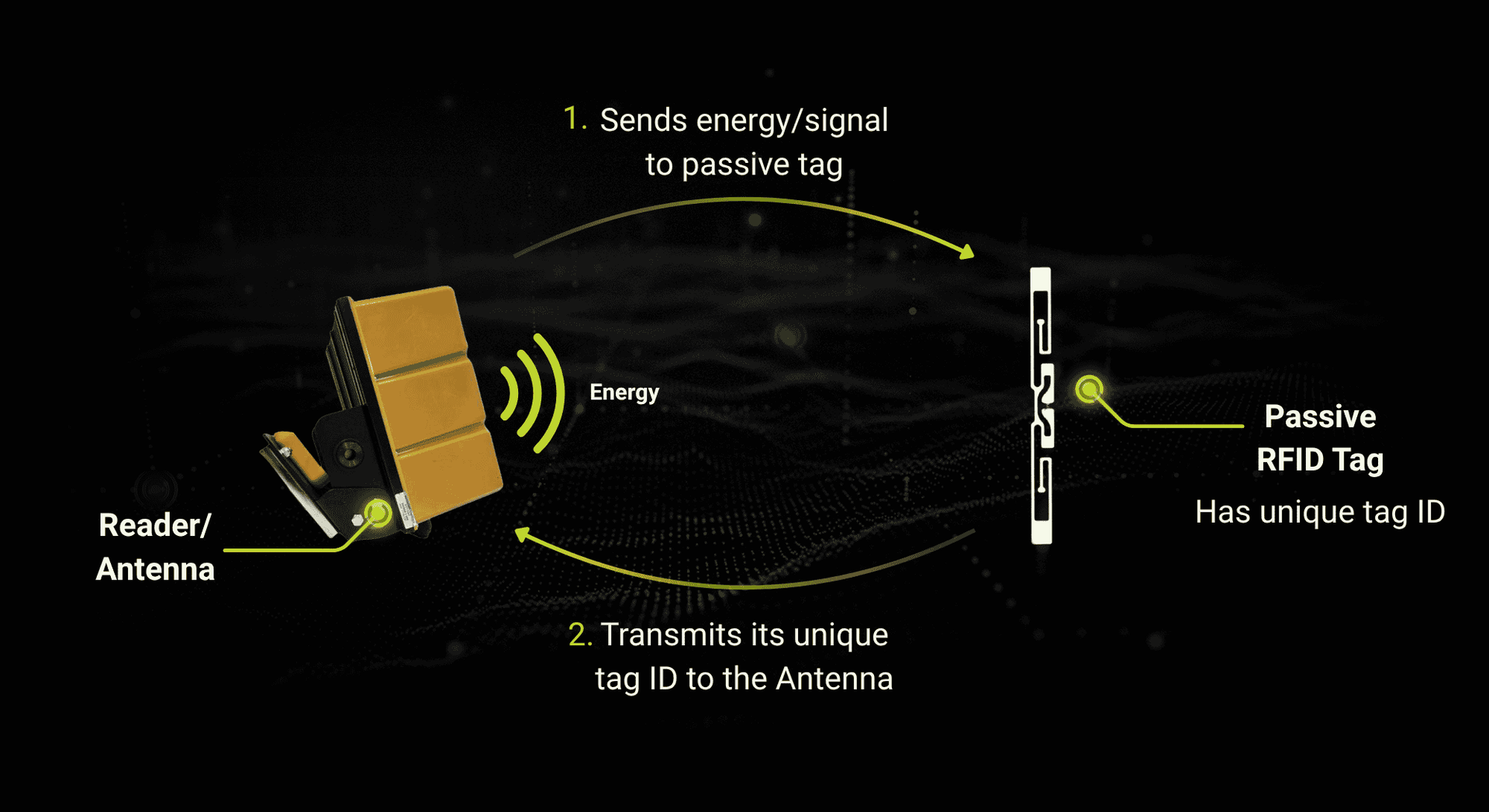
The word "passive" refers to how the tags are powered. Passive RFID tags contain no internal battery. Instead, they draw the small amount of energy they need from the radio signal sent by a nearby reader antenna. When the antenna's signal reaches the tag, the tag responds with its unique identification data.
This simple design gives passive RFID several practical advantages:
- No batteries to replace or charge on the worker
- No Maintenance cycles for individual tags
- Long lifespan, often lasting 20+ years with normal use
- Durable construction that stands up to tough environments
- Compact design, weighing virtually nothing and taking up no space
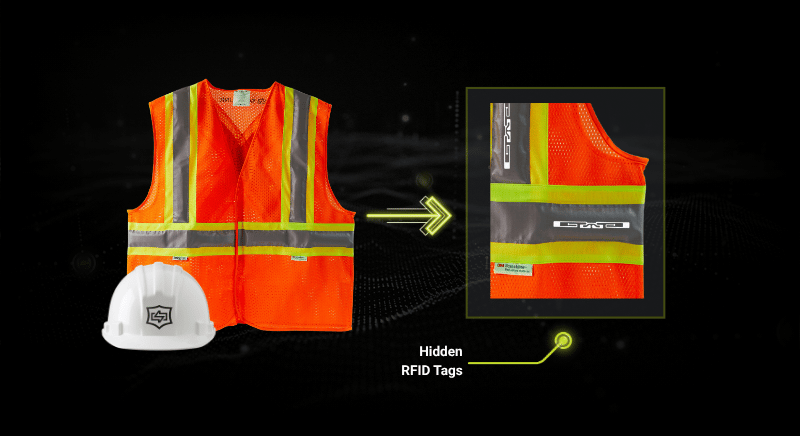
In a safety context, passive RFID tags can be embedded directly into vests, marker tags, and attached to hard hats. This lets a system detect the presence of a tagged worker or a marked hazard without relying on the worker to carry, charge, or manage any device.
How Does Passive RFID Work? — Step-By-Step
Passive RFID works through a straightforward exchange between three core parts: the tag, the reader antenna, and the system that interprets the data. Here is how detection happens in an industrial worksite safety setting.
Passive RFID Tags
Each tag holds a unique identifier. It has no power source of its own. It stays completely inactive until it enters the signal range of a reader antenna.
RFID Readers & Antennas
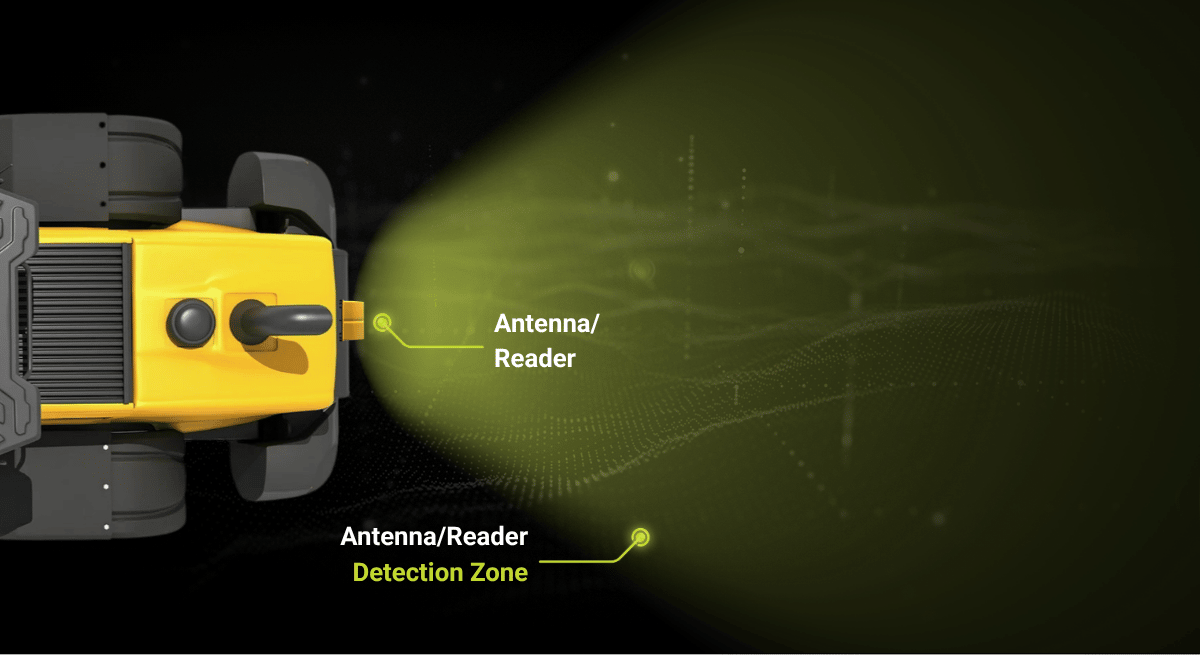
An antenna mounted on a piece of equipment continuously sends out a radio signal, creating a detection zone around the machine. This zone can be adjusted based on the application and the level of coverage required.
How Detection Happens
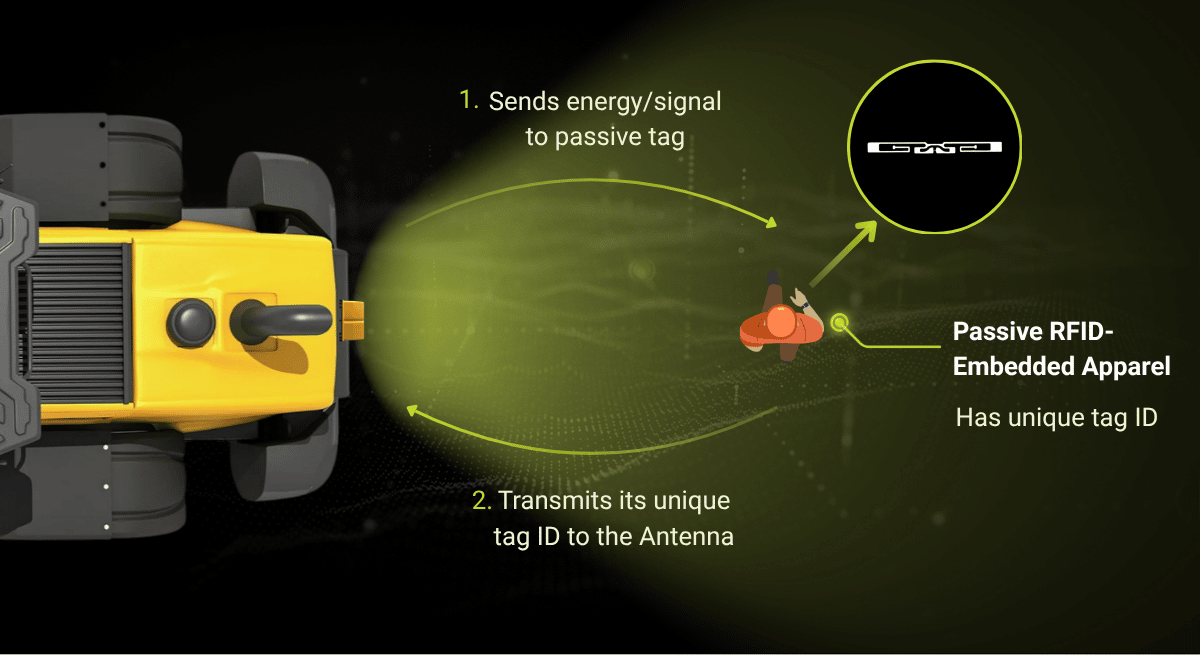
When a tagged worker steps into the detection zone, the antenna's signal energizes the passive tag. The tag then transmits its unique ID back to the antenna, confirming that a tagged person is present.
What Happens When a Tag Enters a Danger Zone?
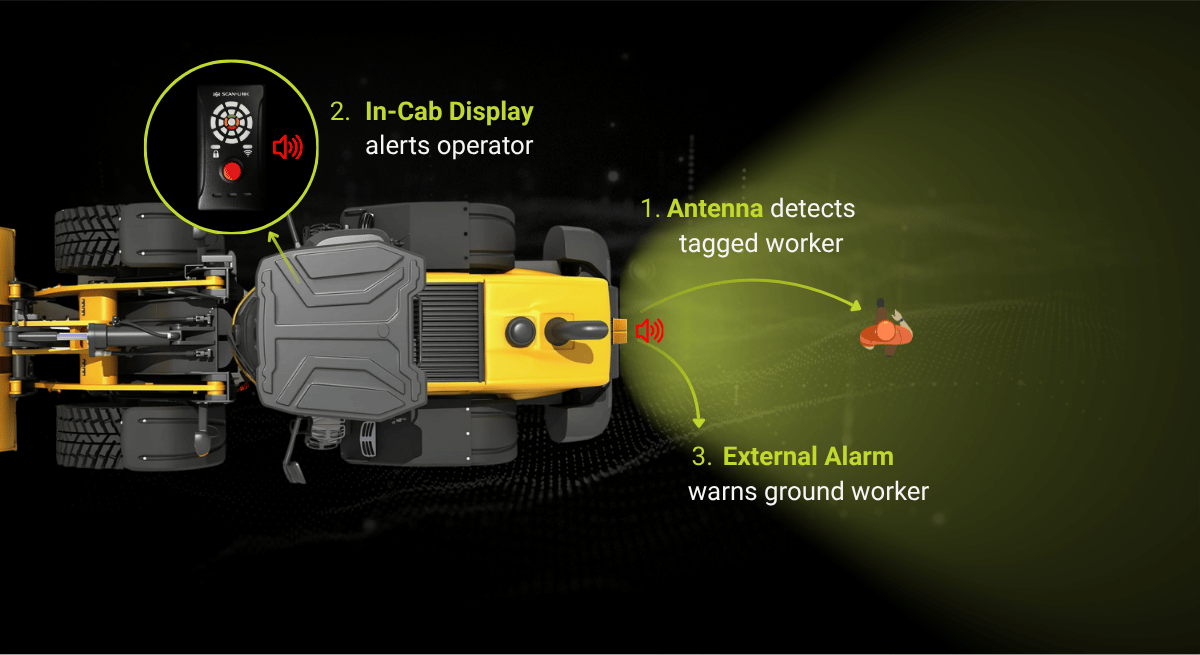
In a passive RFID detection system, detection triggers an immediate response:
1. The antenna detects the tagged worker inside the detection zone.
2. The in-cab display alerts the operator with a visual and audible warning.
3. An external alarm warns the ground worker that they are too close to the equipment.
4. The system logs the event with a time, date, and tag ID for later review.
This two-way alert cuts through jobsite noise and gives both the operator and the worker time to respond before an incident occurs.
Passive RFID vs Active RFID
Both passive and active RFID identify tagged items, but they work differently and suit different needs. The key difference is power: passive tags have no battery, while active tags carry their own power source and broadcast a signal continuously.
For worksite safety programs that depend on consistent performance and low upkeep, this distinction matters.
Passive RFID
Active RFID
Power Source:
No battery; powered by the reader antenna
Power Source:
Internal battery
Maintenance:
Virtually none
Maintenance:
Battery replacement & monitoring required
Tag Lifespan:
20+ years
Tag Lifespan:
Limited by battery life (generally 3-5 years)
Cost per Tag:
Lower
Cost per Tag:
Higher
Suitability for PPE:
Excellent; virtually no weight and embeds easily in safety vests & existing hard hats
Suitability for PPE:
Less practical; adds weight & upkeep
Detection:
Detects within a defined zone
Detection:
Continuous broadcast over longer ranges
Program Upkeep:
Virtually none
Program Upkeep:
Higher; battery programs across all tags
Active RFID can offer longer detection ranges, which suits certain asset-tracking tasks. However, for personnel detection, UHF passive RFID tags can detect tagged PPE at distances of around 25 feet, with adjustable ranges depending on the application and system setup. In the context of proximity detection around mobile equipment, that detection range provides meaningful distance for both operators and ground workers to respond.
For person detection on busy jobsites, passive RFID also removes the burden of managing batteries across an entire workforce. That simplicity keeps the system dependable and easy to adopt, while providing the detection range needed for practical worker proximity applications.
Why Passive RFID Is Useful for Heavy Equipment Safety
Heavy equipment operates in environments where maintaining awareness of nearby personnel is critical. Passive RFID technology enhances worker safety by automatically detecting personnel wearing passive RFID tags as they enter designated detection zones and alerting operators in real time. Each tag has a unique ID, enabling person-specific detection while helping reduce false alarms.
Built to withstand harsh industrial environments, passive RFID tags require no batteries or maintenance and are designed to last more than 20 years, providing a reliable, low-maintenance solution that also generates valuable safety data and analytics.
No Batteries or Maintenance

Passive RFID tags require no batteries or charging, making them completely maintenance-free once deployed. This eliminates the need for ongoing upkeep while ensuring reliable, long-term operation.
No False Alarms

The system responds only to tagged workers or tagged assets, not random objects or debris. This prevents false alarms that can lead to operator fatigue.
Reliable In Harsh Conditions

The system is designed to perform reliably in hazardous industrial conditions, maintaining consistent performance in dust, dirt, rain, snow, fog, and low-light conditions commonly found on active jobsites.
Actionable Safety Insights

Detection data provides insight into where interactions between workers and equipment occur, helping identify high-risk areas, uncover recurring trends, and support continuous improvements to jobsite safety.
Passive RFID Enables Person-Specific Detection
When passive RFID tags are embedded in safety vests or affixed to hard hats, the system detects one thing with confidence: a tagged worker in the danger zone. Gravel piles, parked trailers, and swinging loads carry no tag, so they never trigger an alert.
This is true person-specific detection. Because every warning signals a real person, operators stay responsive, false alarms drop, and alarm fatigue fades. That reliability builds the trust that turns a safety system into a safety habit for your entire crew.
How Passive RFID Helps Prevent Struck-By Incidents
Passive RFID helps in several ways:
- Early Detection: The antenna identifies a tagged worker the moment they enter the danger zone.
- Two-Way Alerts: The operator is warned inside the cab, and the ground worker is warned outside, so both parties can act.
- Automatic Event Logging: Every detection event is recorded, giving safety teams the data on near-misses and high-risk areas on their jobsite
That logged data turns everyday detections into insight. Safety leaders can identify patterns, target high-risk zones, and support training with objective evidence and insights.
Passive RFID for Proximity Detection Systems
A Proximity Detection System, also sometimes referred to as "Proximity Warning System" or "Proximity Alert System", is only as good as its ability to detect reliably in low visibility, in bad weather, and without constant maintenance. Passive RFID addresses these challenges by detecting specifically tagged personnel or tagged assets rather than simply responding to motion or nearby objects.
A passive RFID proximity detection system detects specifically tagged personnel rather than simply responding to motion or nearby objects, meaning operators receive alerts only when a tagged worker enters the configured detection zone. This helps eliminate false alarms. Battery-free RFID tags also eliminate the ongoing maintenance associated with battery-powered wearables while remaining unaffected by darkness or glare that can limit optical-based technologies.
With no batteries to maintain and long-lasting RFID tags (typically lasting 20+ years), passive RFID provides a robust, reliable, and low-maintenance solution for proximity detection around heavy equipment. For a deeper look at how proximity detection works and what to look for in a system, see our full guide below.

The SCAN~LINK proximity detection system detecting a ground worker
Passive RFID in Industrial Applications
Passive RFID technology is highly adaptable and supports diverse industrial environments where the interaction between people and mobile equipment is critical. Key industries leveraging this solution include:






Trusted by Leading Companies














FAQs
Find answers to common questions about passive RFID technology, how it works, and how it supports worker detection, asset identification, and safety applications.
What is passive RFID?
Passive RFID is a wireless technology that uses battery-free tags and reader antennas to detect and identify tagged people or assets within a defined range.
How does passive RFID work?
An antenna sends out a radio signal that energizes a nearby passive tag. The tag responds with its unique ID, confirming its presence so the system can trigger an alert and/or log the event.
What is the difference between passive and active RFID?
Passive tags have no battery and are powered by the reader antenna. Active tags carry their own battery and broadcast continuously. Passive RFID needs less maintenance and suits PPE, while active RFID offers longer ranges.
Does passive RFID require batteries?
No. Passive RFID tags have no internal battery. They draw the energy they need from the reader antenna's signal, which means no charging and no battery replacement.
Can passive RFID be used for worker safety?
Yes. Passive RFID is widely used in worker detection systems to identify tagged personnel around heavy equipment and to support struck-by incident prevention.
How far can passive RFID tags be detected?
Detection range depends on the tag type, antenna/reader configuration and system installation. Passive RFID detection ranges can be customized to suit the application, from shorter focused zones, to extended coverage areas for larger equipment and work environments.
SCAN~LINK uses Ultra-High-Frequency (UHF) tags which offer a longer read range. Maximum detection range varies whether a worker is wearing both a tagged vest and hard hat, or just a vest or just a hard hat. Range is adjustable up to 10m (33ft).
Can passive RFID work in harsh outdoor environments?
Yes. Passive RFID performs reliably in dust, dirt, low light, and other difficult conditions.
Can passive RFID tags be used in safety vests and hard hats?
Yes. Because passive RFID tags have no battery, they can be embedded into vests and can be attached onto hard hats easily, turning your everyday PPE into wearable technology that supports safety and awareness.
Does passive RFID replace other safety measures?
Absolutely not. Passive RFID adds a layer of automatic detection and supports existing safe work procedures, training, and site control, but it does NOT replace them.
A passive RFID detection system should not be relied upon as the sole means of worker safety and protection.
How does passive RFID help with safety reporting?
Learn More About SCAN~VUEEach detection event is logged with a time, date, and tag ID. This creates an objective record that safety teams can use to spot near-misses, target high-risk areas, and support training.
To learn more about telematics, data & analytics, visit our SCAN~VUE & Telematics page.
We're Here to Support Your Safety Goals
Contact us to learn how SCAN~LINK’s passive RFID safety solutions improve safety and compliance, or request pricing and a detailed quote tailored to your jobsite.
Contact Us
Contact Us
13 Windward Dr.
Unit 204
Grimsby, Ontario
L3M 4E8
T: 1-905-304-6100
Toll Free: 1-866-554-5582
info@scan-link.com