
Why Person-Specific Detection Matters for Worker Safety Systems
When an alarm sounds on a busy jobsite, people need to know what it means. If a detection system regularly responds to objects, debris, or other non-hazardous conditions, repeated alerts can become easy to ignore. Person-specific detection is designed to identify the presence of a worker, rather than simply detecting something inside a defined area.
By using passive RFID tags integrated into PPE, the system can recognize tagged workers and trigger an alert when they enter a designated danger zone. On this page, you’ll learn how person-specific detection works, why passive RFID is well suited to it, and how more precise detection can support faster, more confident responses.
What Person-Specific Detection Means for Worker Safety
Person-specific detection is a worker detection approach designed to identify people rather than general movement or objects around mobile equipment. With passive RFID, a proximity detection system can recognize tagged workers and trigger an alert when they enter a defined danger zone.
This distinction matters on busy worksites, where equipment, materials, debris, and normal site activity can create unnecessary detections. By focusing detection on tagged workers, person-specific detection helps make alerts more relevant, reducing false alarms and alarm fatigue while giving operators and workers clearer information about when a person is actually inside the detection zone.

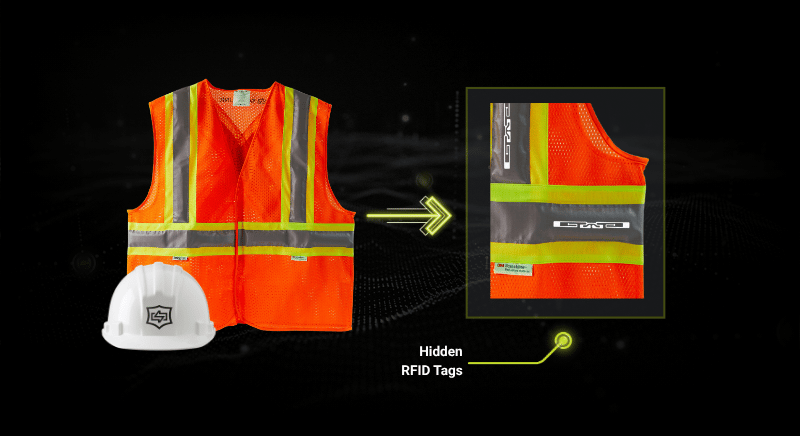
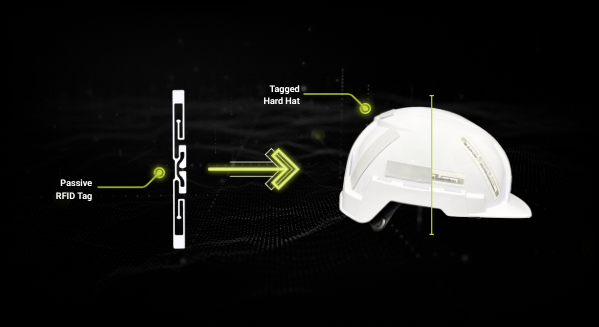
Passive RFID tags are hidden in safety PPE, enabling the antenna/reader to detect the tagged worker specifically.
How Passive RFID Delivers Person-Specific Detection
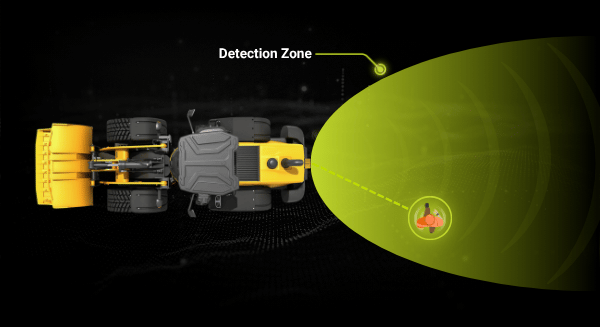
Passive RFID achieves this precision through a simple and reliable principle. The reader antenna mounted on a piece of equipment responds only to passive RFID tags and nothing else. It does not react to gravel piles, parked trailers, blowing debris, or the general movement of a working site. The antenna sends out a radio signal that creates a defined detection zone, and it is listening for one specific thing: the response of a passive RFID tag.
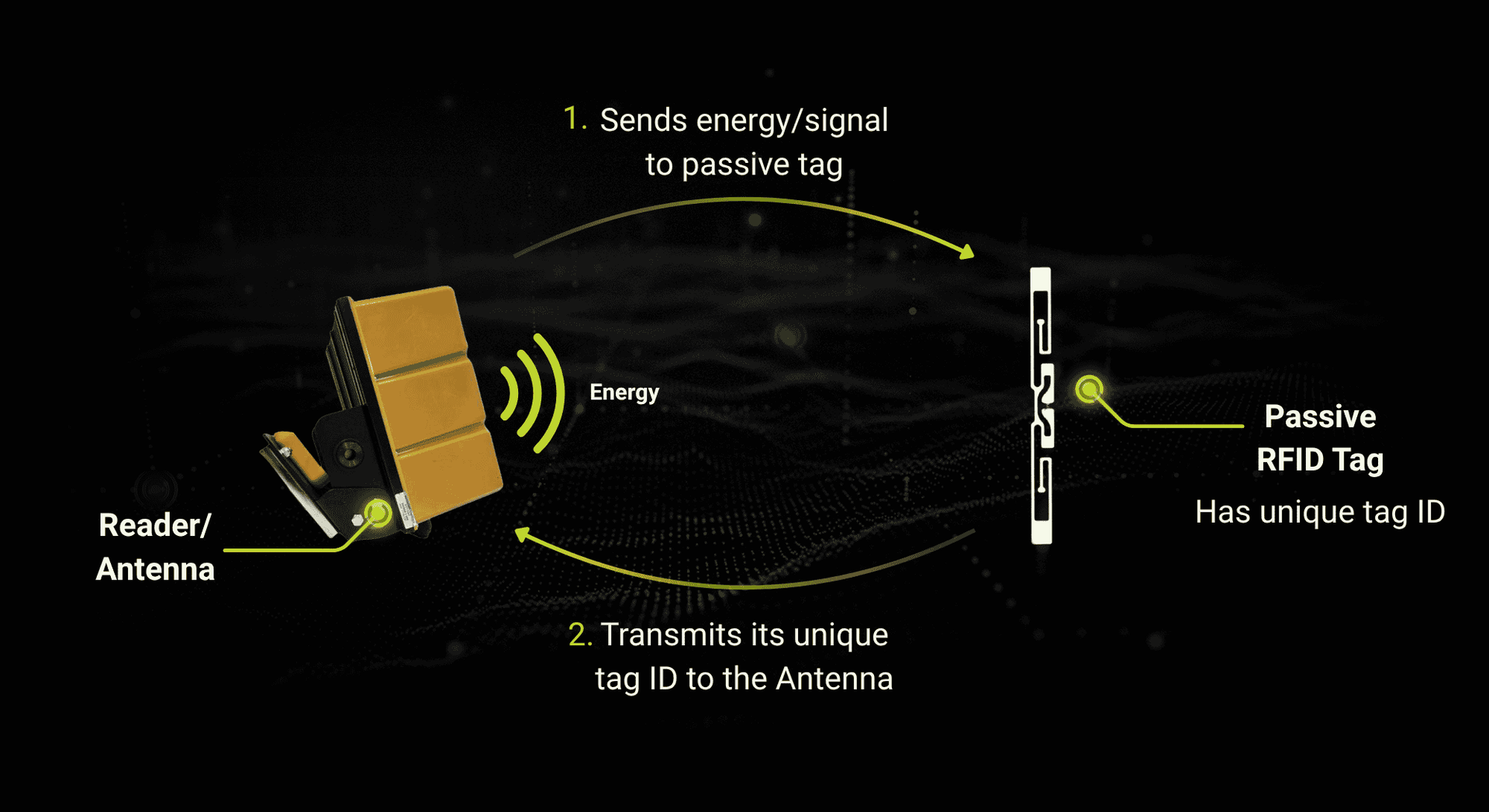
Passive RFID Tags
Each tag holds a unique identifier. It has no power source of its own. It stays completely inactive until it enters the signal range of a reader antenna.
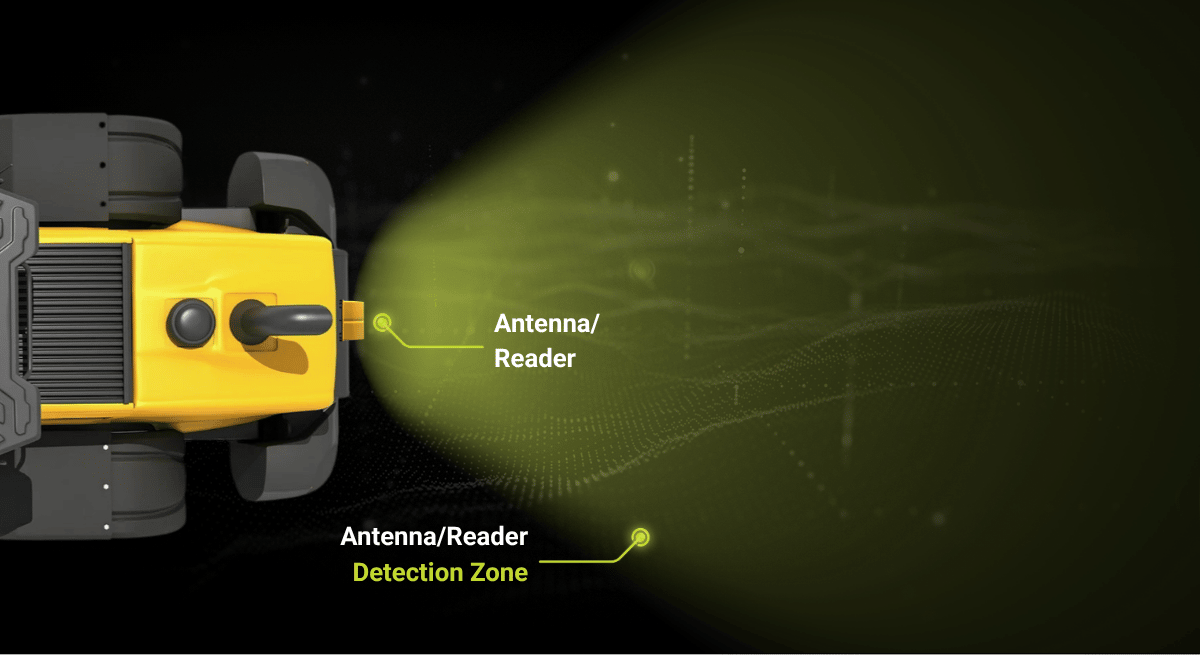
RFID Readers & Antennas
An antenna mounted on a piece of equipment continuously sends out a radio signal, creating a detection zone around the machine. This zone can be adjusted based on the application and the level of coverage required.
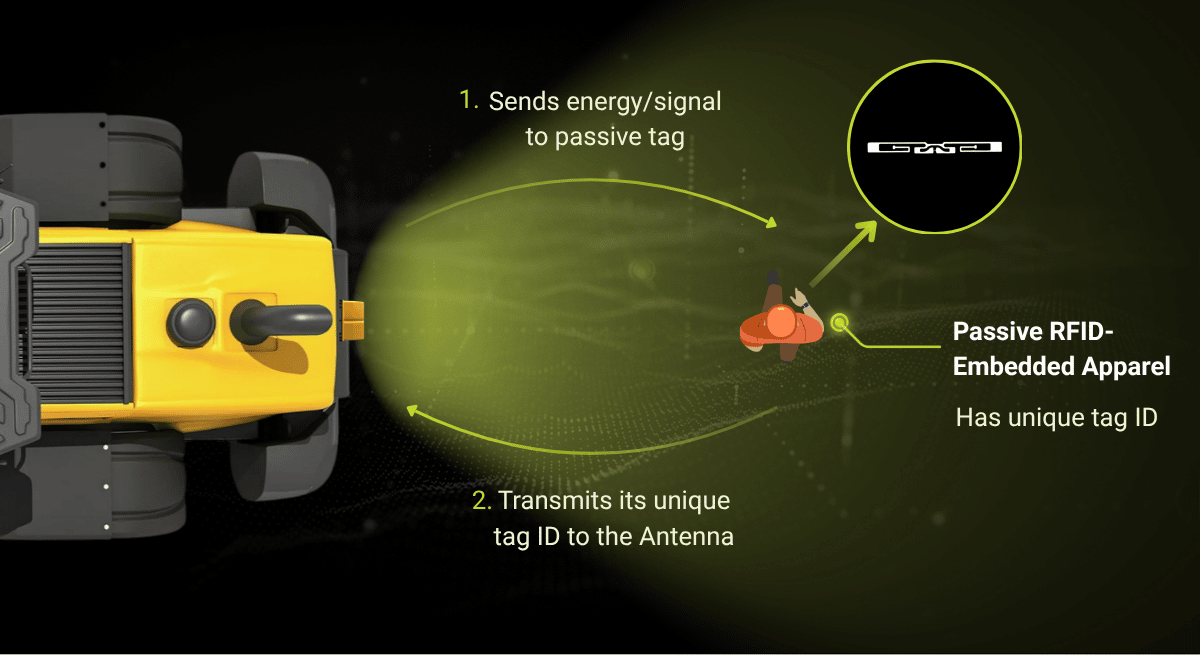
How Detection Happens
When a tagged worker steps into the detection zone, the antenna's signal energizes the passive tag. The tag then transmits its unique ID back to the antenna, confirming that a tagged person is present.
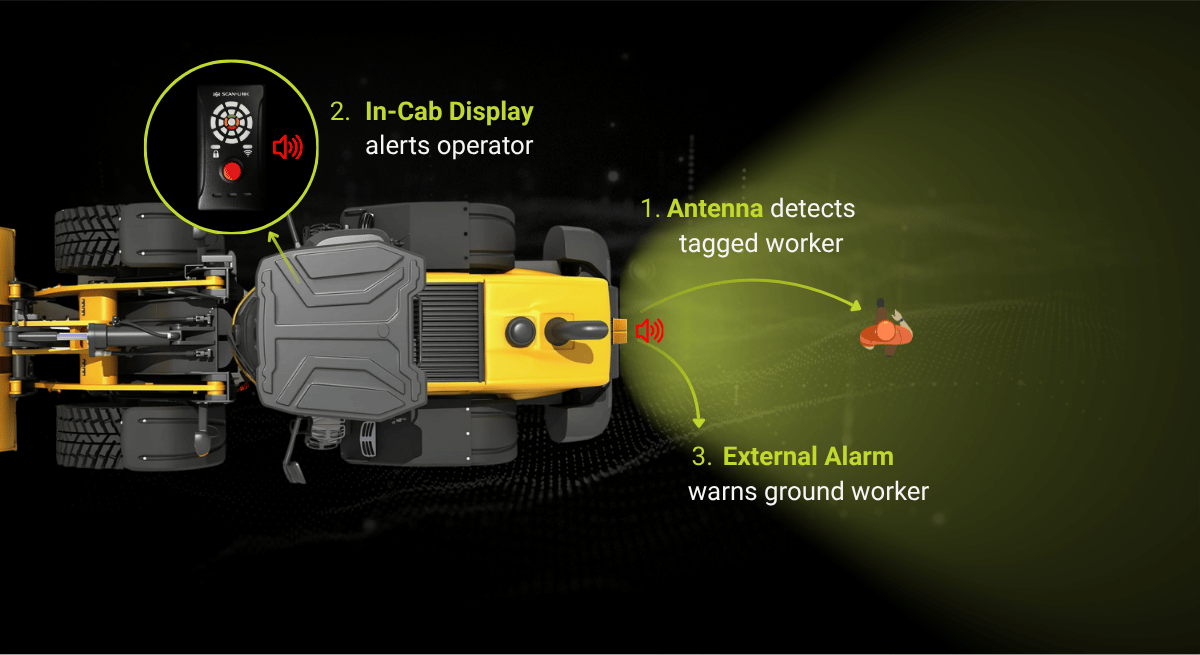
What Happens When a Tag Enters a Danger Zone?
In a passive RFID detection system, detection triggers an immediate response:
1. The antenna detects the tagged worker inside the detection zone.
2. The in-cab display alerts the operator with a visual and audible warning.
3. An external alarm warns the ground worker that they are too close to the equipment.
4. The system logs the event with a time, date, and tag ID for later review.
This two-way alert cuts through jobsite noise and gives both the operator and the worker time to respond before an incident occurs.
Because the system only recognizes passive RFID tags, the detection is inherently person-specific. When those tags are built into the PPE your crews already wear, the only thing the system detects is a worker in tagged safety gear. A pile of aggregate, a stationary trailer, or a swinging load carries no tag, so it never triggers an alert.
RFID-Embedded Safety Apparel: Turning Everyday PPE Into Wearable Protection
The most dependable safety technology is the kind your crews never have to think about. By integrating battery-free passive RFID tags directly into the vests and hard hats your workers already wear, standard PPE becomes wearable detection technology that works automatically.
No Extra Devices to Carry or Charge
Passive RFID tags are lightweight, compact, and embedded or affixed discreetly into safety gear. SCAN~LINK safety vests come with passive RFID tags embedded directly behind 3M™ Scotchlite reflective tape. Passive tags are also affixed onto the interior or exterior of an existing hard hat, adding no meaningful weight and requiring no separate device for a worker to remember, carry, or activate. There are no wearables to charge overnight, no batteries to swap out, and no equipment for workers to sign in and out at the start of a shift.
This matters on a busy jobsite. Any safety measure that depends on workers managing an extra device introduces a point of failure. A dead battery, a forgotten unit, or a device left in a truck can leave someone unprotected at the exact moment protection counts most. Embedded passive RFID removes that risk entirely. If a worker is wearing their required PPE, they are detectable.
Protection That Fits Into Existing Routines
Because the tags live inside gear your crews already put on, adoption is effortless. There is no new habit to build and no training curve to overcome. Workers continue doing exactly what they already do: wearing their vest and hard hat. The detection capability simply comes along with them.
For safety leaders, this delivers several practical advantages:
Consistent Coverage
When passive RFID is built into mandatory PPE, protection is applied uniformly across your entire workforce rather than depending on individual compliance with a separate device.
Reduced False Alarms
Battery-free tags require no charging cycles and no upkeep programs, so your team spends its time on safety outcomes rather than managing hardware.
Long-Term Reliability
Passive RFID tags are built to withstand demanding conditions and are designed to last for 20+ years, holding up to the dust, moisture, and wear of daily jobsite use.
Effortless Scalability
Outfitting new hires or expanding to another site is as simple as issuing tagged PPE and placing passive RFID tags onto existing hard hats, making it easy to extend protection as your operation grows.
Turning the PPE your crews already trust into wearable detection technology is one of the most practical ways to strengthen worker safety without adding complexity to your operation.
How This Eliminates False Alarms at the Source
Passive RFID prevents false alarms from occurring in the first place, because the antenna simply does not respond to anything that is not a tagged worker.
For jobsite leaders, this changes the entire character of a pedestrian detection system:

- Alerts carry meaning
because each one represents a real person in a real hazard zone.

- Safety data stays clean, since every logged event reflects a genuine worker interaction rather than a false trigger.

- The system stays dependable across shifts, seasons, and conditions, with no ongoing effort to suppress nuisance alerts.
Eliminating false alarms at the source is what separates a system your crews trust from a system they learn to ignore.
Understanding Alarm Fatigue and Its Cost
Alarm fatigue is a well-documented risk in any environment where warnings fire too often. When alerts sound repeatedly for conditions that pose no real threat, people naturally begin to tune them out. It is a predictable human response, not a sign of carelessness. Over time, a system that warns too often becomes background noise, and the one alert that truly matters can be lost in the clutter.
On a jobsite, the cost of alarm fatigue is measured in safety. Consider what happens as nuisance alerts accumulate:
- Operators start dismissing alerts because most of them have proven false.
- Response times slow down, since a warning that is usually meaningless does not prompt urgent action.
- Crews build habits around ignoring warnings, which is the opposite of what any safety program intends.
- Trust in the system erodes, and a safety tool that is not trusted is a safety tool that is not used.

This is the quiet danger behind excessive false alarms. The problem is not simply the annoyance of frequent beeping. It is the gradual training of your people to stop paying attention, which undermines the very protection the system was installed to provide.
How Meaningful Alerts Restore Operator Trust & Responsiveness
Person-specific detection addresses alarm fatigue at its root. Because passive RFID responds only to tagged workers, every alert an operator receives is meaningful. Each alert signals that a real person has entered a danger zone. This dramatically reduces the flood of nuisance alerts that erode attention and slow reaction times.
When operators trust that an alert means something, they respond to it consistently and quickly. There is no hesitation to weigh whether this particular warning is worth acting on. The alert is credible, so the response is immediate.

- Operators stay alert and responsive
because every warning demands and deserves attention.

- Reaction times improve, when alerts are trusted rather than second-guessed.

- Safety performance strengthens as the system consistently delivers the right information at the right moment.
A detection system earns its value not by producing the most alerts, but by producing the right ones.
Building Trust Between the Operator and Ground Workers
Trust is what turns a safety system into a safety habit. When operators believe an alert means something, they respond to it every time. When workers on foot know the external alarm sounds only when someone has genuinely entered a hazard zone, they take that warning seriously too. That shared confidence is difficult to build when a system fires constantly, because constant noise teaches everyone to ignore it.
Person-specific detection creates alignment between the cab and the ground. Both the operator and the worker respond to the same trustworthy signal, at the same moment, for the same reason. The operator receives a clear in-cab alert while the worker on foot receives an external warning, and both parties know the warning is real. This two-way clarity closes the gap between awareness and action.

Extending Detection to Tagged Assets and Hazards
Person-specific detection protects your people, but the same passive RFID technology can do more. The reader antennas that identify tagged workers can also identify specific tagged assets, equipment, and fixed hazard zones, giving operators a fuller picture of what sits inside a danger zone.
The principle stays exactly the same. A reader antenna responds only to passive RFID tags, so anything you want the system to recognize simply needs to carry a tag. When an asset or a defined hazard is tagged, it becomes detectable in the same reliable way a tagged worker is, without adding batteries, wiring, or ongoing maintenance to manage.
Assets and objects can be tagged using SCAN~LINK Marker Tags
SCAN~LINK Marker Tags
SCAN~LINK Marker Tags extend passive RFID worker detection to the assets and hazard areas that matter most on your site. These battery-free tags can be attached to physical equipment, high-value assets, or fixed hazard zones, giving safety and operations teams the flexibility to choose what they want the system to detect.
Marker Tags also give operators a clear distinction between people and assets. When SCAN~LINK's Armour System™ detects a Marker Tag, distinct audible and visual cue indicate that an asset or tagged object has been detected rather than a person. Operators can then differentiate between a person being detected vs. a tagged object/asset being detected.

The result is a more informative proximity detection system that can distinguish between tagged workers and tagged assets, while giving site leaders control over what the system detects.
Turn Precision Into Protection
Person-specific detection matters because precision is what makes a worker detection system worth trusting. By responding only to passive RFID tags worn by your crews, the technology eliminates false alarms at the source, defeats alarm fatigue before it starts, and builds the shared trust that keeps operators and ground workers acting on every warning that counts.
To explore the passive RFID technology behind this approach, return to the Understanding Passive RFID hub for more resources. If you have any questions, want more information, or wish to request a quote tailored to your jobsite, send us a message!
Explore More About Passive RFID Technology, Safety PPE, and Proximity Detection Systems

Understanding Passive RFID
Learn about passive RFID detection technology and how it can be applied in a worker safety context.

Passive RFID-Tagged PPE
Learn more about passive RFID-embedded safety vests and tagged hard hats and how they help with reducing false alarms on the jobsite.
What is a Proximity Detection System?
Learn what proximity detection systems are, how they work, and how they help protect workers around heavy equipment.
FAQs About Person-Specific Detection & False Alarms
Find answers to common questions about person-specific detection, false alarms, alert fatigue, and how RFID worker detection can help make proximity alerts more relevant.
What is person-specific detection, and how does it differ from general detection?
Person-specific detection means the system detects tagged people only. When passive RFID tags are embedded in safety vests or affixed to hard hats, the reader antenna responds solely to those tags. It does not react to gravel piles, parked trailers, or blowing debris.
General detection approaches respond to a wide range of conditions on a busy site, which can produce alerts that do not point to a real hazard. This risks frequent false alarms and noise fatigue.
How does passive RFID reduce false alarms?
Passive RFID prevents false alarms at the source. Because the antenna only recognizes passive RFID tags, it never triggers on arbitrary objects, materials, or general movement around the machine.
The result is a system where every alert carries meaning, since each one represents a real person in a real hazard zone.
Your safety data also stays clean, because every logged detection event reflects a genuine worker interaction rather than a nuisance trigger.
How does the system build trust with operators and ground workers?
Trust comes from meaningful alerts. When operators know an alert signals a real worker, they respond to it consistently and quickly. When ground workers know the external alarm sounds only when someone genuinely enters a hazard zone, they take that warning seriously too.
This shared confidence creates alignment between the cab and the ground, with both parties responding to the same trustworthy signal at the same moment.
Does passive RFID detection replace other safety measures?
No. Passive RFID detection adds a dependable, automated layer of protection that supports your existing safety program. It should never be relied upon as the sole means of protection.
The strongest safety outcomes come from combining detection technology with your current procedures, training, supervision, and site controls. Used together, passive RFID gives operators and ground crews a signal they can trust in the moments that matter most, while your broader safety program addresses the full range of jobsite risks.
We're Here to Support Your Safety Goals
Contact us to learn how SCAN~LINK’s passive RFID safety solutions improve safety and compliance, or request pricing and a detailed quote tailored to your jobsite.
Contact Us
Contact Us
13 Windward Dr.
Unit 204
Grimsby, Ontario
L3M 4E8
T: 1-905-304-6100
Toll Free: 1-866-554-5582
info@scan-link.com