Conveyor Safety in Waste & Recycling: Why Visibility Alone Is Not Enough
The U.S. Bureau of Labor Statistics consistently ranks the broader waste management and remediation sector among the most hazardous industries in the country, and proximity to moving equipment remains a persistent driver of serious incidents.
The uncomfortable truth is that most of these hazards are already known. Facilities post signage, run training, and mark high-risk zones. Yet workers still end up in the wrong place at the wrong moment. This post explains why that happens, why visibility measures alone fall short, and how layered safety systems and worker detection technology help close the gap.
Here is what this blog covers:
- Why proximity hazards persist even in well-run facilities
- The limits of existing visibility aids
- What a layered safety system actually looks like
- Where passive RFID worker detection fits

SCAN~LINK installed on a BOMAG landfill compactor
Why Proximity Hazards Persist
Conveyor and mobile equipment incidents rarely happen because someone did not know the danger existed. They happen because conditions change faster than people can react.
A worker can step sideways to clear a jam and enter a blind spot, or a loader can reposition and obscure a ground worker. Dust, debris, or poor lighting conditions can quickly cut sightlines. On active sort lines or tipping floor transfer stations, the environment is never static, and human attention has real limits. No operator can watch every detection at once, and no ground worker can predict every machine movement.
The core problem is that awareness between people and equipment breaks down at exactly the moments when the risk is highest.
Takeaway: Known hazards still cause incidents because dynamic jobsite conditions can outpace human reaction time.
Why Visibility Alone Is Not Enough
Most facilities rely on some combination of mirrors, cameras, and audible reversing alarms. These tools help, but each has clear limits in a dynamic waste and recycling setting.
- Mirrors depend on the operator looking in the right direction at the right moment, and they still leave blind spots.
- Cameras improve coverage but require the operator to watch a screen while managing the machine.
- Beepers and reversing alarms become background noise on a loud site, and workers quickly grow desensitized to them.
The common thread is that every one of these depends on human vigilance. They assume someone is watching, listening, and interpreting correctly at all times. In a high-noise, high-motion environment, that assumption fails often enough to matter.
Takeaway: Visibility tools support awareness, but they cannot guarantee it because they still rely on constant human attention.
What a Layered Safety System Looks Like
Leading operations no longer treat safety as a single control. They build layered systems, where multiple independent measures reduce the chance that any one failure leads to an incident. If one layer misses, another catches it.
A practical layered approach in waste and recycling typically includes:
- Training and safety culture so workers recognize hazards and speak up.
- Clear procedures for lockout, zone entry, and equipment interaction.
- Physical controls such as guarding, barriers, and defined walkways.
- Administrative controls like route planning, signage, and traffic separation.
- Detection technology that provides awareness when line of sight and human attention fall short.
Each layer addresses a different failure point. Training changes behaviour, procedures set expectations, physical controls create separation, and detection technology adds a real-time safeguard that does not depend on someone happening to look up.
Takeaway: Resilient safety comes from independent layers, not a single tool.
Where Passive RFID Worker Detection Fits
Detection technology is the layer most facilities have historically lacked. This is where proximity detection systems, and specifically passive RFID worker detection, add value that cameras and mirrors cannot.
Passive RFID works by embedding small, battery-free tags into safety apparel such as vests and hard hats. An antenna mounted on equipment continuously scans for those tags. When a tagged worker enters a defined danger zone, the system alerts the operator immediately, warns the worker, and logs the event automatically.
Three characteristics make this approach well suited to waste and recycling:
- It detects people specifically. The system responds to tagged workers, not random objects, which reduces false alarms and alarm fatigue.
- It requires no batteries on workers. Passive tags need no charging and no maintenance, so adoption stays simple.
- It creates a data trail. Every detection is time-stamped and recorded, giving safety leaders near-miss data to support continuous improvement and compliance audits.
That combination fills the exact gap left by visibility tools: awareness that works even when no one is looking, in the dust, noise, and motion of a live facility.
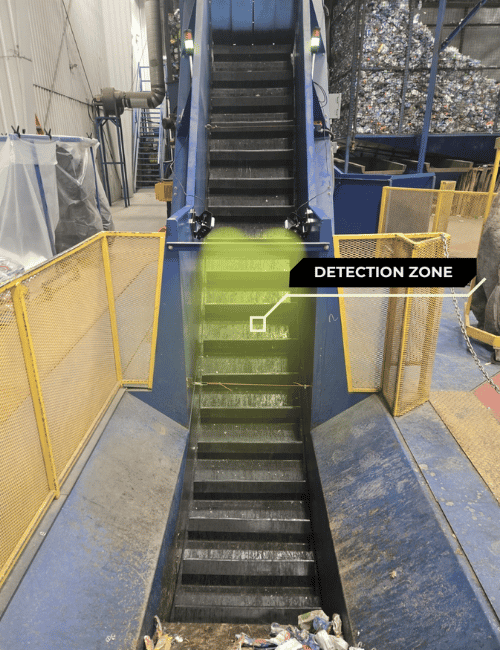
SCAN~LINK installed on a conveyor system
Takeaway: Passive RFID adds person-specific, low-maintenance detection with an auditable record of proximity events.
Moving From Awareness to Prevention
Conveyor and mobile equipment hazards will not disappear from waste and recycling operations, but they can be managed far more effectively. The facilities making the most progress accept that visibility alone cannot carry the load. They combine strong culture, clear procedures, physical controls, and detection technology into a system designed to catch failures before they become injuries.
These are the same challenges SCAN~LINK explored in the Waste Advantage Magazine July 2026 Safety Supplement, which examines how proximity detection and passive RFID support safer operations across waste and recycling facilities. You can read more about that feature on our Waste Advantage feature page.
If you are evaluating how to add a detection layer to your existing safety program, explore our
waste and recycling safety solutions to see how passive RFID worker detection fits into a layered approach built for real facility conditions.
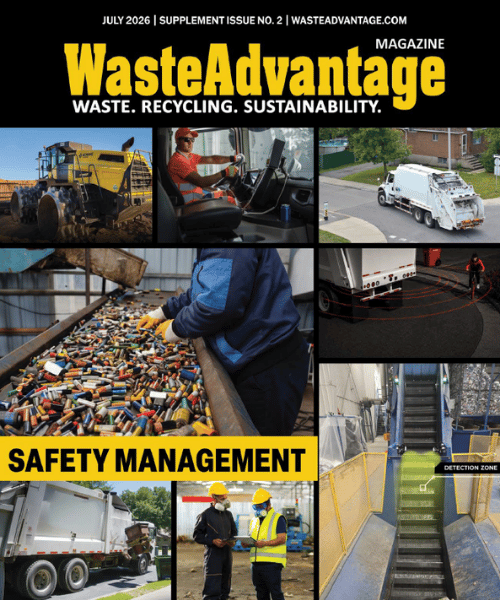
July 2026 Waste Advantage Magazine Cover — this issue features a thought leadership article by the SCAN~LINK team. Click here to read.